Why Jackson Homes Sink: The Yazoo Clay Problem
If you own an older home in Jackson, you've likely noticed something unsettling: floors that slope gently toward the center of the house, or worse, a noticeable dip in the middle of a room. This isn't just a cosmetic issue. The culprit often lies beneath your home, in the foundation soil itself.
Jackson and the surrounding Mississippi region sit atop Yazoo clay, a dense, moisture-sensitive soil that expands and contracts dramatically with seasonal changes. During wet periods, this clay absorbs water and swells. During dry seasons, it shrinks and pulls away from the foundation. Over decades, this cycle causes uneven settling, which places enormous stress on the floor framing system above. The foundation shifts, the floor joists lose their level support, and gravity does the rest. What starts as a minor slope becomes a safety concern and a structural liability.
The problem compounds when crawlspaces lack proper drainage and ventilation. Water pools under the house, keeping the soil perpetually damp and unstable. Homeowners often don't realize the connection between their soggy crawlspace and their sagging living room floor, but the relationship is direct and undeniable.
How Floor Joists Fail and What Sagging Floors Tell You
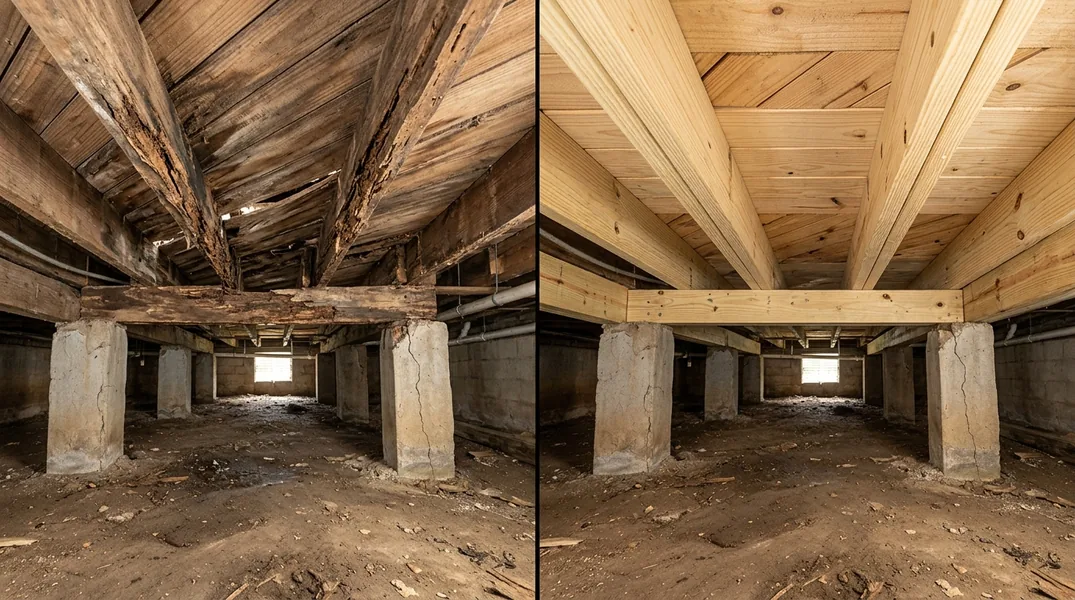
Floor joists are the horizontal wooden beams that support your floor and distribute the weight of everything above them (furniture, people, walls) down to the foundation. In older homes, these joists were typically 2x8 or 2x10 dimensional lumber, spaced 16 inches apart. When the foundation shifts or settles unevenly, those joists lose their level bearing. They begin to deflect, or sag, under the weight they're designed to carry.
A sagging floor is your home's way of sending a distress signal. Early signs include squeaky floorboards, doors that won't close properly, visible gaps between walls and ceilings, or that distinctive sloping sensation when you walk across a room. If you notice any of these symptoms, it's time to get a professional inspection. Ignoring the problem allows the joists to continue bending, which can lead to permanent deformation, cracking, or even failure. In severe cases, joists can rot or develop wood rot and dry rot, especially if they're in contact with damp crawlspace conditions.
Many homeowners also discover that their floor joists have been compromised by termite damage, which weakens the wood and reduces its load-carrying capacity. Termites, moisture, and foundation movement often work together to create the perfect storm for structural failure.
Sagging Floor Repair Cost in Jackson: What to Budget
The cost of sagging floor repair depends on several factors: how many joists are damaged, the severity of the sag, whether the foundation itself needs attention, and the accessibility of the crawlspace. A simple repair involving one or two compromised joists might run between $1,500 and $3,500. More extensive work, such as repairing multiple joists or installing additional support beams, can range from $5,000 to $15,000 or more. If foundation issues are the root cause, you may need to address drainage, soil stabilization, or even foundation repair, which adds significantly to the total cost.
The good news is that delaying repair only increases expense. A minor sag that costs $2,000 to fix today could become a major structural problem costing $20,000 in five years. Jackson Carpentry recommends getting a free estimate as soon as you notice signs of floor movement. We'll inspect your crawlspace, assess your foundation, and provide transparent pricing for the work needed. Call us at (601) 524-2500 to schedule an evaluation, or visit our website to request a free estimate.
Many homeowners are surprised to learn that addressing the underlying foundation problem (drainage, moisture control) often costs less than repeatedly repairing sagging floors. Investing in both the joist repair and the foundation solution is the most cost-effective long-term strategy.
Sistering Floor Joists: The Gold Standard Repair Method
When floor joists have lost their structural integrity but the wood itself isn't completely rotted, sistering is the preferred repair method. Sistering involves installing a new, identical joist (or a reinforced beam) directly alongside the damaged joist, fastening them together with bolts and steel plates. This creates a composite beam that shares the load and restores the floor's level and strength.
The sistering process begins with a thorough crawlspace inspection. Our team identifies which joists are sagging, measures the deflection, and checks for rot, termite damage, or moisture problems. We then install temporary support posts to lift the floor back to level, carefully and gradually, to avoid cracking walls or damaging plumbing and electrical systems. Once the floor is level, we install the sister joist, bolt it securely to the original, and add steel reinforcement plates at critical points. The temporary supports are then removed, and the repaired joists permanently support the floor in its correct position.
Floor Joist & Subfloor Repair through sistering is effective, non-invasive, and preserves the original structure of your home. It's also faster and less disruptive than removing and replacing entire joists. For homeowners in Jackson dealing with sagging floors, sistering is often the answer.
Addressing the Root Cause: Foundation and Crawlspace Solutions
Repairing sagging joists without fixing the underlying foundation problem is like treating a symptom without curing the disease. The floor will likely sag again. That's why Jackson Carpentry always investigates what caused the sag in the first place. In most cases, it comes down to three issues: poor drainage, inadequate crawlspace ventilation, or structural failure of the foundation itself.
Poor drainage allows water to pool under your home, keeping Yazoo clay perpetually saturated. Installing or improving drainage systems, such as perimeter drains and sump pumps, can stabilize the soil and prevent future settling. Crawlspace encapsulation, which involves sealing the crawlspace with vapor barriers and installing a dehumidifier, dramatically reduces moisture and protects wood joists from rot and decay. In some cases, the foundation has shifted so severely that it needs structural intervention. This is where Beam Replacement & Load-Bearing Wall Removal expertise becomes essential. Our team can install adjustable posts or new beams to provide permanent, stable support.
The combination of joist repair, moisture control, and foundation stabilization creates a complete solution. Your floors will be level, your home will be safe, and you'll have peace of mind knowing the problem won't return in a few years.
When to Call a Professional for Sagging Floor Repair Near Me
Sagging floors are not a DIY project. The structural calculations, the temporary support systems, the precise measurement and installation of sister joists, and the assessment of foundation problems all require professional expertise and specialized equipment. Mistakes can be costly and dangerous. A poorly installed sistering job can fail under load, causing catastrophic damage. An incorrect assessment of foundation issues can lead to incomplete repairs and recurring problems.
Jackson Carpentry has been serving homeowners in Jackson for years, diagnosing and fixing sagging floors caused by Yazoo clay, crawlspace moisture, and structural decay. Our team understands the unique challenges of older homes in Mississippi. We use proven methods, quality materials, and a commitment to doing the job right the first time. If you've noticed your floors sagging, doors sticking, or cracks appearing in your walls, don't wait. Contact Jackson Carpentry at (601) 524-2500 today to schedule your free estimate. We'll inspect your home, identify the problem, and provide a clear path to repair.
Looking for a professional carpentry contractor in Jackson? Jackson Carpentry responds fast for all your carpentry needs.
Get a Free QuoteOur services: Wood Rot & Dry Rot Repair · Termite Damage Repair · Floor Joist & Subfloor Repair